Healing is also a way of seeing.
Art and medicine have never been as far apart as training sometimes makes them feel. This page gathers teachers, projects, and surgeon-artists whose work speaks to perception, resilience, and care — from Rachel Naomi Remen, MD, and The Healer’s Art, to Juana Alicia’s SANARTE murals at UCSF, to a mural with survivors of gun violence, to Dr. Geoffrey Dunn on what still defines a surgeon as AI advances.
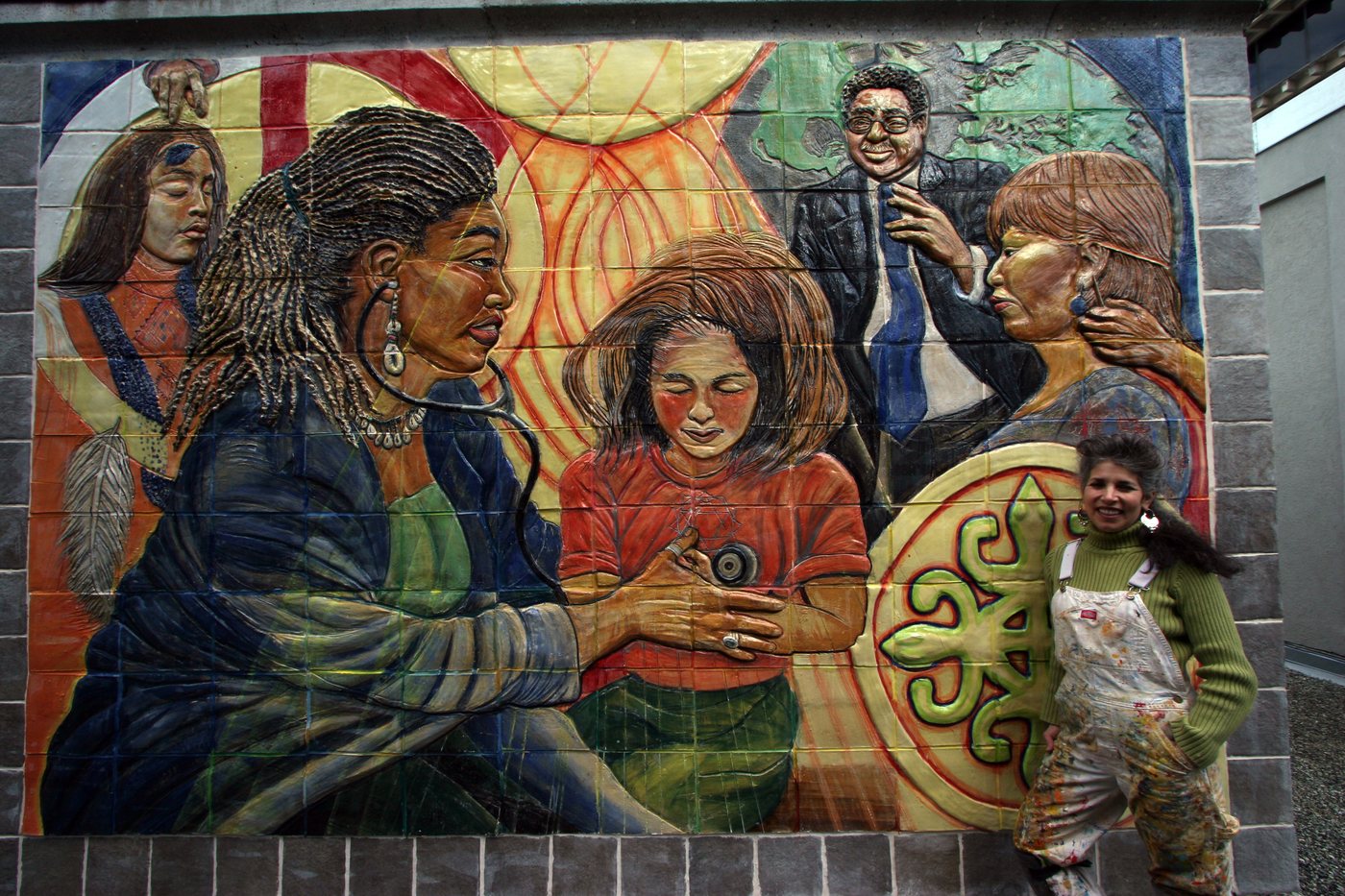 Juana Alicia with Traditions, SANARTE: Diversity’s Pathway/Sendero de la diversidad, UCSF, © 2005. More below
The Healer’s Art, and stories that heal
Rachel Naomi Remen, MD (1938–2026), was a physician and longtime UCSF School of Medicine faculty member, creator of The Healer’s Art course, and author of Kitchen Table Wisdom and My Grandfather’s Blessings.
I first read Rachel Naomi Remen’s writing long before medical school. At UCSF, I had the great privilege of taking The Healer’s Art while she was still teaching it. Her work has stayed with me for decades, reminding me that listening, story, and human connection belong at the center of medicine.
I suspect that the most basic and powerful way to connect to another person is to listen. Just listen.
— Rachel Naomi Remen, MD, Kitchen Table Wisdom
Murals of healing traditions
Juana Alicia is a Chicana muralist, printmaker, sculptor, illustrator, and painter whose work addresses social justice, gender equality, environmental crisis, and the power of resistance. At UCSF she created SANARTE: Diversity’s Pathway/Sendero de la diversidad (2005): four ceramic bas-relief murals, a ceramic tile frieze, and a cement walkway at the Ambulatory Care Clinic on Parnassus Avenue. In her words, the murals represent healing traditions worldwide, community cooperation, the internal work we do to heal ourselves, and the movements that brought about diversity. In Traditions, pictured at the top of this page, a woman with a stethoscope listens to a girl’s heart. The Helix Pathway, inlaid with a DNA molecule, runs from the clinic building to the bus stop on Parnassus, connecting the medical center to its community.


I loved SANARTE as a medical student, and I served on the planning committee for UCSF’s 2008 commemoration of the murals. They were a big part of what made me feel at home and welcome at UCSF. They were so colorful, happy, and empowering, and they still are, in my memory. ¡Strike!, which honors the 1968 actions at UCSF for civil rights, labor rights, and peace, has taken on another layer of meaning for me: I ended up going on strike myself as a resident in Buffalo.
On October 23, 2026, I met Juana Alicia at Balmy Alley, where she was finishing a new mural.
Health runs through her other murals, too. Las Lechugueras (The Women Lettuce Workers), a Mission District mural that has since been destroyed, showed women harvesting lettuce while a plane sprays pesticides overhead. She has described it as autobiographical, drawn from her years in the Salinas lettuce fields and the pesticide poisoning she had while pregnant. The Spill/El Derrame, in Berkeley, is dedicated to all life in the Gulf of Mexico after the Deepwater Horizon oil spill.
I feel that it is my responsibility as an artist to be an activist for social justice, human rights, and environmental health.
— Juana Alicia, on The Spill/El Derrame
- SANARTE: Diversity’s Pathway (juanaalicia.com)
- Las Lechugueras: The Women Lettuce Workers (juanaalicia.com)
- The Spill/El Derrame (juanaalicia.com)
- Juana Alicia’s murals and artist biography
- Oral history interview with Juana Alicia, 2000 (Smithsonian Archives of American Art)
- Campus Community Commemorates ‘Spirit of Diversity’ Mural (UCSF, 2008)
More of SANARTE on this site: ¡Strike! on Advocacy and Traditions on About.
Peace in Our Neighborhood
During medical school I collaborated with the Wraparound Project at San Francisco General Hospital on Peace in Our Neighborhood — a mural-based violence prevention, healing, and community recovery project with survivors of gun violence, with Dr. Rochelle Dicker.

The Wraparound Project
More of this thread lives on Advocacy.
Surgery, art, resilience — and AI

Dr. Geoffrey Dunn is a retired general surgeon widely recognized for helping bring palliative care into surgical practice. He is also a painter. In the ACS Bulletin he asks what still defines a surgeon when robotics, imaging, and AI reshape operative technique — and answers with the cultivated capacity to see, a lesson he first heard in art school: you are not here to learn how to draw; you are here to learn how to see.
As AI Advances, What Defines a Surgeon? ACS Bulletin 2026
Surgeon-Artists, Unite! Group Seeks to Forge Network of Creativity — a General Surgery News “Between Two Scalpels” interview (October 2023) with Dr. Dunn and Dr. Gerald Marks about the art group they started for surgeons and physicians.
Geoffrey Dunn at Pucker Gallery — his artist page at the gallery that has represented his paintings since 2020.
Surgeon as Artist — his essay proposing fine art practice as a model for professional formation, reflective capacity, and surgical education, shared here with his permission.
The Bulletin piece also belongs on the Working with AI page, because the question is as much about technology as it is about identity.
Surgeon Artists League
The Surgeon Artists League provides a framework for collegial communication, collaboration, and education among surgeon artists dedicated to promoting the value and presence of art in the surgical and medical community. Dr. Dunn discusses the League in his ACS Bulletin viewpoint as a space for cultivating the perceptual habits that underlie surgical judgment.