There is more than one way in
A surgical resident on Instagram was recently surprised to learn that surgeons can train in hospice and palliative medicine. Nothing had been missed for lack of looking. The possibility had simply never been presented. That is a different kind of educational gap from the ones we usually discuss. It isn’t about what we teach. It’s about which futures we make visible, and it belongs to the same family of questions as the hidden curriculum.
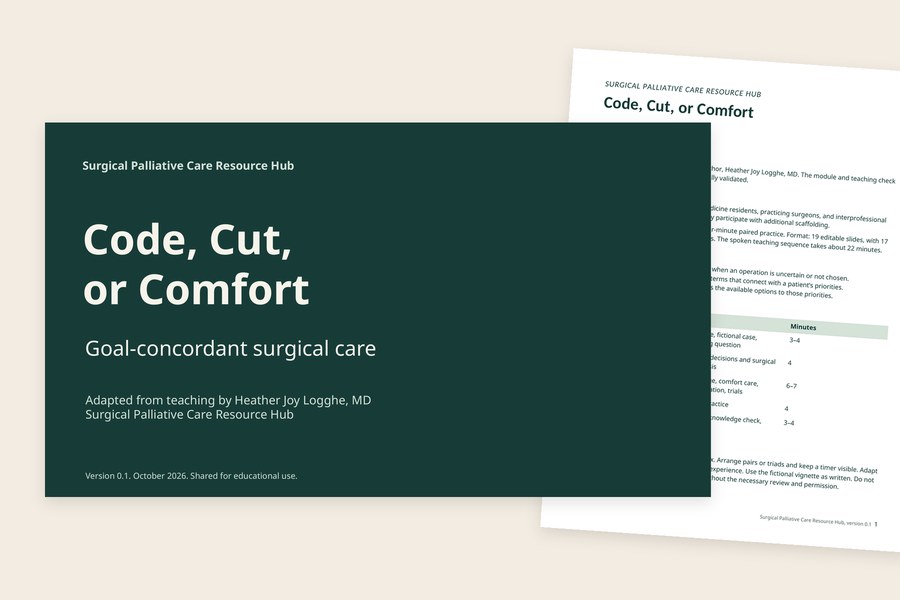
Educational resources for surgeons and health professionals
Every surgeon needs the foundational skills of primary palliative care. Beyond them, palliative expertise isn’t all-or-nothing. Between learning a few communication techniques and completing a full fellowship lies a real spectrum, and different points on it suit different surgeons at different stages of a career. Courses, certificates, and degrees build skills; only accredited fellowship training leads to subspecialty board eligibility.
Where I’d start, whatever your path
A course in goals-of-care conversations. One of the most useful trainings I’ve done was VitalTalk’s. It isn’t labeled palliative care, but it is palliative care, and it’s also a set of skills every clinician needs, in every specialty.
- Mastering Tough Conversations: short online preparation, then two four-hour live virtual sessions practicing serious news and goals-of-care conversations with simulated patients and a small group of peers.
- Navigating Serious Conversations: a self-paced online course in three modules, if a live course isn’t possible right now.
- VitalTalk Tips: a free app for iPhone and Android with short, evidence-based tips for specific conversations.
See VitalTalk’s current courses for dates and fees.
-
Learning in practice
Builds skillsResidency teaching, palliative care rotations, mentorship from palliative care colleagues, and deliberate practice in family meetings. This is where most surgeons start, and where much of the learning keeps happening.
-
Focused courses
Builds skillsShort courses in serious-illness communication and symptom management, many offering CME. Examples include VitalTalk’s courses, among them Best Case/Worst Case, a framework developed for conversations about surgery and its alternatives, and the clinical courses of the Center to Advance Palliative Care, mostly available through member organizations.
-
Graduate certificate
Builds skillsStructured graduate-level study without leaving practice. The University of Colorado Anschutz Interprofessional Palliative Care Graduate Certificate, for example, is 12 credits, online, and can be completed in about nine months.
-
Master’s degree
Builds skillsDeeper interprofessional training in palliative care. That same certificate’s credits count toward CU Anschutz’s Master of Science in Palliative Care. A certificate or master’s degree, on its own, does not lead to board eligibility.
-
HPM fellowship
Toward board certificationA 12-month, ACGME-accredited fellowship. Surgeons can enter after three clinical years of residency, taking a year away from clinical training as I did, or after completing residency. With primary certification from the American Board of Surgery, fellowship graduates can pursue subspecialty certification in HPM; since 2022, surgeons apply for it through the American Board of Internal Medicine.
-
A fellowship for established physicians
Toward board certificationFor physicians who can’t leave a practice, a family, and a community for a year. CU Anschutz’s Community Hospice and Palliative Medicine Fellowship is an ACGME-accredited, part-time, largely online pathway completed over three to four years alongside the Master of Science in Palliative Care, for physicians at least five years beyond residency by the time they finish. Completing both is required for board eligibility. Its participants have included a practicing trauma surgeon and surgical ICU director.
Each step is a complete answer for someone. Few surgeons need all of them.
Programs named here are examples, not endorsements or a complete list. Requirements change: confirm current details with each program, with the American Board of Surgery, and with ABIM before committing. Last checked November 2026.
A fuller guide is on the way
I’m writing a longer piece for The Listening Surgeon, working title A Palliative Care Training Ladder for Surgeons, on what each of these pathways involves in practice and on the structural barriers that make additional training so hard for surgeons already established in their careers.
It will be linked here when it’s published.
Organizations
 American Academy of Hospice and Palliative Medicine
The professional home for physicians and clinicians in hospice and palliative medicine: education, career resources, and information on subspecialty certification. (opens in a new tab)
 Center to Advance Palliative Care
Online clinical training in communication, pain, and symptom management for clinicians in every specialty. (opens in a new tab)
 VitalTalk
Evidence-based training in serious-illness communication, including the Best Case/Worst Case course for surgical decisions. (opens in a new tab)
Further reading on careers
- Surgical Palliative Care: Considerations for Career Development in Surgery and Hospice and Palliative Medicine Ellison, Lau, Cook, Hoffman, Berlin. ACS RISE, 2021.
- Hospice and Palliative Medicine Fellowship after Surgical Training: A Roadmap to the Future of Surgical Palliative Care Bassette et al. Journal of Surgical Education, 2022;79(5):1177–1187.
- Development of Surgical Palliative Care as a Field and Community Building in Palliative Care: Past, Present, and Future Directions McCammon, Hoffman. Annals of Palliative Medicine, 2022;11(2):852–861.
Teaching resources
Teaching materials and clinical tools live in one place: the Surgical Palliative Care Resource Hub. It gathers published teaching resources, materials shared by educators, key papers from the field, and validated prognosis tools.
 For educators
Surgical Palliative Care Resource Hub
Teaching resources on serious-illness conversations and surgical decisions, key resources from the field since 1998, and prognosis tools.
Teaching across disciplines? The Hub separates resources for every discipline from tools specific to surgical care.