Health Equity
Black women’s health: the numbers, the stories behind them, and what each of us can do.
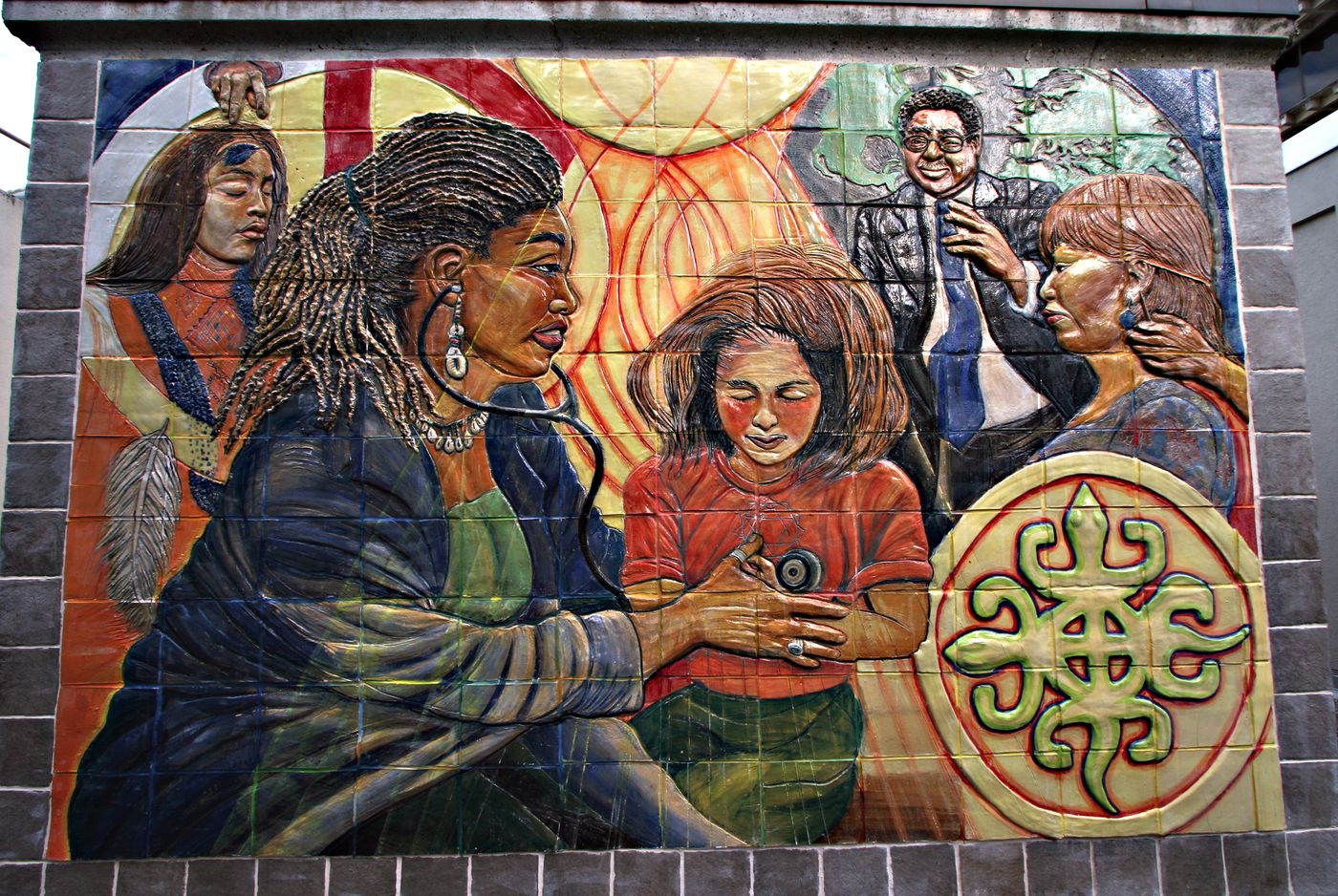
Traditions, by Juana Alicia, UCSF
Black women’s health
In 2024, Black women in the United States died of maternal causes at more than three times the rate of White women: 44.8 versus 14.2 deaths per 100,000 live births (CDC, 2026). Black women are also 38% more likely than White women to die of breast cancer, despite slightly lower incidence (American Cancer Society, 2025). These are not new numbers. What would it take for them to change, and who gets to study why they exist?
That second question is not abstract. In March 2025, with the study more than halfway through, the National Institutes of Health ended funding for a Detroit study of nearly 600 Black mothers and their babies, led by epidemiologists Jaime Slaughter-Acey and Dawn Misra, which asked how stress from poverty and racism may shape outcomes such as preterm birth. NIH said the award “no longer effectuates agency priorities” (Michigan State University, May 2025). In its series When Care Gets Cut, in an installment with family physician Dr. Bayo Curry-Winchell, Take Back Trust put it plainly: “We cannot fix what we refuse to study.”
Behind the numbers
Behind the numbers are stories. After giving birth in 2017, Serena Williams, who has a history of blood clots, had to insist on the CT scan that found a clot in her lungs; a nurse suggested her medication was making her “talk crazy” (in her own words, Elle, 2022). After her second cesarean, at the Reno hospital where she was a medical director, Dr. Bayo Curry-Winchell told her nurse again and again that something was wrong and was told she was fine. She was bleeding internally and needed surgery and a transfusion (Ms., 2026). One of the most famous athletes in the world, and a physician in her own hospital. If they had to fight to be believed, what happens to everyone else?
It connects to threads elsewhere on my Advocacy page: helping people reach reproductive care, hosting Harriet Washington at UCSF, and who gets to become a surgeon. On my bookshelf: Say Anarcha, about the enslaved women on whom J. Marion Sims developed his fistula operation; Washington’s Medical Apartheid; Uché Blackstock’s Legacy; and Passion and Purpose: Black Female Surgeons.
What each of us can do
More than 80% of pregnancy-related deaths in the United States are preventable (CDC, 2022). Prevention is something people do, one decision at a time. Here is where I would start.
Everyone
- Learn the urgent maternal warning signs. They matter for a full year after a pregnancy, not just until delivery. If you or someone you love has one, say out loud: “I am pregnant,” or “I was pregnant in the last year.”
- Find, or nominate, a clinician who listens on Clinicians Who Care, Dr. Bayo’s crowd-sourced list (more on Patient Voices).
- Give to, and share the work of, the Black-led organizations below.
- Ask your representatives about a full year of postpartum Medicaid coverage, insurance coverage for doulas, and research funding for Black maternal health.
Clinicians & practitioners
- Believe her. When a Black woman tells you something is wrong, work it up as if it is.
- Ask about pregnancy in the past year, in the emergency department, urgent care, clinic, and before surgery. More than half of pregnancy-related deaths happen between a week and a year after delivery, and among Black women the leading cause is cardiac (CDC, 2022). Postpartum chest pain and shortness of breath deserve a full workup.
- Use what already works: the AIM patient safety bundles for hemorrhage, hypertension, and more, and CDC’s Hear Her materials for your team.
- Look at your own outcomes by race and ethnicity. We cannot fix what we refuse to measure.
- Offer breast cancer risk assessment by age 25, as the American College of Radiology now recommends for all women, and especially for Black women.
White clinicians
- Check what you were taught. In one study, about half of White medical students and residents endorsed false beliefs about biological differences between Black and White people, such as thicker skin, and those who held more of them rated a Black patient’s pain lower and made less accurate treatment recommendations (Hoffman et al., 2016).
- Learn the history our training left out, beginning with Anarcha, Betsey, and Lucy, and with Medical Apartheid.
- Do the work yourself instead of handing it to Black colleagues, who already carry more than their share of committee, mentoring, and diversity work.
- Sponsor, not just mentor: put Black women’s names forward for roles, invitations, authorship, and pay.
- When you see a patient dismissed, say something, in the room if you can.
Organizations leading this work
 Black Mamas Matter AllianceAdvancing Black maternal health, rights, and justice; launched Black Maternal Health Week, April 11–17
National Birth Equity CollaborativeFounded by obstetrician-gynecologist Dr. Joia Crear-Perry to advance birth equity
 Black Women’s Health ImperativeFounded in 1983 by Byllye Avery as the National Black Women’s Health Project
 Sisters Network Inc.The first national Black breast cancer survivorship organization, founded in 1994 by survivor Karen Eubanks Jackson
 Take Back TrustReproductive health platform founded by clinician and author Nikki Sapiro Vinckier; home of When Care Gets Cut
Accounts to follow on Instagram
- @doctor.bayoDr. Bayo Curry-Winchell, family physician in Reno, founder of Clinicians Who Care, and host of Beyond Clinical Walls · doctorbayo.com
- @ucheblackstockmdDr. Uché Blackstock, emergency physician, founder of Advancing Health Equity, and author of Legacy
- @doccrearperryDr. Joia Crear-Perry, obstetrician-gynecologist and founder of the National Birth Equity Collaborative
- @blackmamasmatterBlack Mamas Matter Alliance, home of Black Maternal Health Week, April 11–17
Know an account that belongs here? Tell me.
Figures: CDC National Center for Health Statistics, final 2024 data (published March 2026); American Cancer Society, Cancer Facts & Figures for African American/Black People, 2025. Preventability and timing: CDC, 2017–2019 Maternal Mortality Review Committee data (released September 2022). Pain beliefs: Hoffman et al., PNAS, 2016. Breast cancer risk assessment: American College of Radiology, 2023. Last checked October 16, 2026.
More of what I’m working on
 Association of Out Surgeons & Allies
AOSA Advocacy & Activism
 American College of Surgeons
Intimate Partner Violence
 Native American health
Indian Health
 Neurodiversity
 in the Workplace
 What surgery still has to learn
Trauma-Informed Care
 What surgeons see first
Gun Violence
 Burn care
Burn Patient Advocacy
 Co-founded with Dr. Paul Fedak
#UnmaskMedicine
 Physician mental health
Physician Mental Health