Mental Health in Medicine

Medicine trains us to recognize suffering. It has been slower to look at its own.

Psychological well-being is shaped by many things at once: personal history and circumstances, relationships, the work itself, the culture of the places we train and practice, and the policies that govern them. Mental health is part of health, and what physicians face can’t be reduced to a question of individual coping skills.

A pale purple aster opening in late-summer light

If you need support now: in the U.S., call or text 988, any time. Physicians and medical students can also call the Physician Support Line at 1-888-409-0141 on weekdays. More support below.

My interest here reaches beyond what usually goes under the heading of physician wellness. I want to understand how medicine responds to psychological suffering, in patients and in colleagues; how institutions contribute to it; and how professional culture and policy can obstruct, delay, or outright block physicians’ access to mental health care.

Supporting people who are suffering and changing the conditions that contribute to their suffering are related responsibilities. They are not the same responsibility.

Medical culture

Physician mental health and the culture of medicine

Clinical work carries real psychological weight: serious illness and death, error and uncertainty, responsibility for outcomes we can’t fully control. Training and practice add pressures of their own, from hierarchy and long hours to evaluation that can feel inseparable from identity. None of that makes distress inevitable, and not all of it is harmful. But the environment matters, and so does the way a profession talks about the people struggling inside it.

A small mushroom rising from a cushion of bright green moss
Burnout, moral injury, mental illness, suicide risk: four things often run together
Occupational

Burnout

Exhaustion, detachment, and a diminished sense of effectiveness tied to work conditions. The World Health Organization classifies it as an occupational phenomenon, not a medical condition.

Moral

Moral distress and moral injury

Knowing the right thing to do for a patient and being prevented from doing it by the system around you, and the deeper wound when that happens again and again. Wendy Dean and Simon Talbot have argued that much of what gets called burnout is better understood this way.

Clinical

Mental illness

Depression, anxiety, post-traumatic stress, substance use disorders, and other conditions. They may be related to work, unrelated to it, or both, and they are treatable.

Risk

Suicide risk

Not simply the far end of burnout. It reflects many interacting factors, among them mental illness, life events, isolation, and barriers to care, and treating it as a burnout problem misreads it.

Keeping these apart matters. Not all occupational distress is psychiatric illness. Not all psychological suffering originates in the workplace. And changing institutions does not remove the need for individual care: a healthier workplace and good treatment are different things, and some people need both.

What the environment shapes
  • Whether harassment, intimidation, and mistreatment in training are named and addressed, and whether reporting them feels safe. I wrote about this in the context of TIME’S UP Healthcare.
  • Institutional betrayal: harm made worse by an institution’s failure to prevent it or to respond well when it is reported, a concept developed by psychologists Carly Smith and Jennifer Freyd.
  • A professional identity built on enduring hardship without acknowledging it.
  • Stigma about psychiatric treatment, reinforced in writing by the questions on licensing and credentialing applications (more below).
  • Hierarchy and power: whether trainees can raise a concern, ask for help, or say they are not okay. This is part of medicine’s hidden curriculum.

Being encouraged to seek care is not the same as being safe to seek it.

Removing barriers

Removing barriers to mental health care

Physicians should be able to get appropriate mental health care without fearing unnecessary professional consequences. For years, many licensing and credentialing applications asked about any past diagnosis or treatment. In a national survey of nearly 6,000 physicians conducted in 2014, about 40 percent said they would be reluctant to seek formal care for a mental health condition because of concerns about their medical license, and reluctance was higher in states whose applications asked broadly about mental health history (Dyrbye et al., Mayo Clinic Proceedings, 2017).

Late sun breaking through heavy clouds over a dark ridge

Three different questions

One

Do you have a diagnosis?

Having a mental health condition, now or in the past. Common, and on its own says nothing about whether someone can practice safely.

Two

Have you sought treatment?

Therapy, medication, a leave of absence. Getting care is what we want people to do.

Three

Are you currently impaired?

Whether any health condition, physical or mental, currently impairs the ability to practice safely. This is the question that bears on patient safety.

A history of treatment is not evidence of current impairment. Patient-safety oversight matters, and it shouldn’t depend on indiscriminate disclosure of mental health histories. The American Medical Association’s position is that inquiries should focus on whether a current impairment exists, not on past diagnoses or treatment.

Watch

“Removing the Mask”

In her 2023 presidential address to the Association for Academic Surgery, Dr. Carrie Cunningham, then the association’s president and a surgeon at Massachusetts General Hospital, spoke openly about her own depression, anxiety, and substance use disorder. A surgical leader saying that from the podium was huge, and it mattered. The people these application questions deter are our colleagues, and sometimes our leaders.

Watch the address on the AAS website. A later survey of the academic surgery community, with Dr. Cunningham as senior author, found that nearly 1 in 7 respondents had experienced suicidal thoughts in the past year (Annals of Surgery, 2024).

Where reform stands: real progress, and what’s still missing

The Dr. Lorna Breen Foundation is named for an emergency physician who died by suicide in April 2020. It leads ALL IN: Wellbeing First for Healthcare, a coalition of national organizations founded in 2021, which helps licensing boards, hospitals, and other care organizations audit and revise their applications, verifies that intrusive mental health questions are gone, and encourages them to tell health workers that seeking care is safe. Its September 30, 2026 announcement reported, as of September 25, 2026:

46medical licensing boards verified
82licensing boards in all, including pharmacy, nursing, and dental
1,087hospitals, plus 3,306 other care facilities
4.1M+health workers with a safer path to care

For comparison, 29 medical boards were verified in 2024 and 40 in September 2025 (AMA Advocacy Update, October 2, 2026). Figures are the Foundation’s; check the current list on its Wellbeing First Champion Challenge page.

That is real, measurable change, and it came from sustained, collective work across many organizations. It is also incomplete. Not every board or hospital has been verified. Changing an application doesn’t, on its own, change how a credentialing committee responds when a physician discloses treatment, how a residency program handles a request for leave, or whether physicians believe the change is real. As the Foundation’s CEO, Corey Feist, put it, “Changing the paperwork is only the beginning.”


Institutional responsibility, and how to take part

Licensing boards are one door. Hospitals ask similar questions when they credential and recredential physicians, and employers and training programs have forms and cultures of their own. Changing what an application asks is concrete and checkable, which is part of why it matters. It also sends a signal. An institution that urges physicians to seek care while asking them to disclose every past treatment is sending two messages, and people tend to believe the second one.

The organizations below lead this work. I support it, and I want more surgeons to know it exists and how to take part.

Suicide prevention

Physician suicide prevention

We train for years to respond to a cardiac arrest: a protocol, a team, practiced repetition, and the expectation that anyone in the room can start. Many of us receive far less preparation for recognizing that a colleague may be thinking about suicide, asking about it directly, and helping them reach care.

Goldenrod in full bloom against a soft autumn field
What colleagues can do

Notice warning signs, ask directly, stay with the person, and help them connect to care. These are skills. They can be taught, and they can be practiced.

What institutions owe

Reduce the preventable contributors to psychological harm, remove barriers to treatment, and make confidential care easy to reach.

These approaches are complementary, not interchangeable. Preparing colleagues to respond doesn’t excuse an institution from changing the conditions it controls, and better conditions don’t replace the people who notice and act.

What the evidence shows, and what it doesn’t

A large recent review, a 2024 meta-analysis in The BMJ of studies from 20 countries, found that suicide rates among women physicians were higher than in the general population. Among men physicians, rates were not higher than in the general population overall, though they were higher than in other professions of similar socioeconomic status. Over time the gap with the general population narrowed for both, but it persisted for women. The authors caution that suicide deaths may be underreported, possibly more so among physicians, and that most of the data come from Europe, the United States, and Australasia.

Suicide has many interacting causes. No single workplace, policy, or event explains any one person’s death, which is also why prevention has to work on several fronts at once.

If you’re worried about a colleague

The 988 Lifeline’s #BeThe1To campaign offers five steps, with the evidence behind each one.

  1. AskAsk directly whether they are thinking about suicide. Asking doesn’t put the idea in someone’s head.
  2. Be thereListen, and take what they say seriously. You don’t need perfect words.
  3. Help keep them safeReducing access to lethal means saves lives. If someone is in immediate danger, call 911, and stay with them if it’s safe to do so.
  4. Help them connectTo 988, the Physician Support Line, their own clinician, or confidential resources where you work.
  5. Follow upCheck in afterward. Staying connected matters.

The American College of Surgeons collects six actions for surgeons, along with peer-support programs and confidential professional resources.

My own writing on suicide prevention will be collected here as it’s published.

Trauma-informed care

Trauma-informed care, in surgery and beyond

Trauma-informed care is not a branch of mental health treatment. It is a way of practicing, and of running institutions, that recognizes how common trauma is, how it shapes people’s encounters with healthcare, and how care itself can reproduce harm. It belongs in the trauma bay and the clinic, in palliative care conversations, in teaching, and in how leaders respond when someone reports harm, whether that person is a patient or a colleague.

New ivy leaves unfurling along a vine
Seven principles, in practice
SafetyPhysical and psychological. Explaining before touching, examining, or moving someone.
Trust and transparencySaying what will happen and why, then doing what we said.
Agency and informed choiceOffering real choices, including the choice to pause.
PowerNoticing the power in a room, between clinician and patient or attending and trainee, and what it makes people feel able to say.
Recognition without disclosurePracticing as though anyone may carry a trauma history, without requiring anyone to tell us.
Avoiding retraumatizationNoticing when routine practices, such as restraint, exposure, or being talked about instead of to, can echo earlier harm.
Institutional responseHow an institution answers a report of harm can compound it or begin repair.

These overlap with the six principles in SAMHSA’s Concept of Trauma and Guidance for a Trauma-Informed Approach (2014).

This is connected to my longest-running work: survivor advocacy and violence prevention, including emergency department advocacy and crisis-line work. That history is on the Advocacy page, and it isn’t repeated here. For what surgical care can look like when it is centered on the person receiving it, see Surgery & Palliative Care and the path for patients and families.

Writing & reflections

Writing

Little of my published writing is about mental health directly yet. These pieces sit close to it: the culture physicians train in, and the conditions they work under.

More of my essays are on the Writing page. To hear when new ones are published, subscribe on Substack.

Voices I learn from

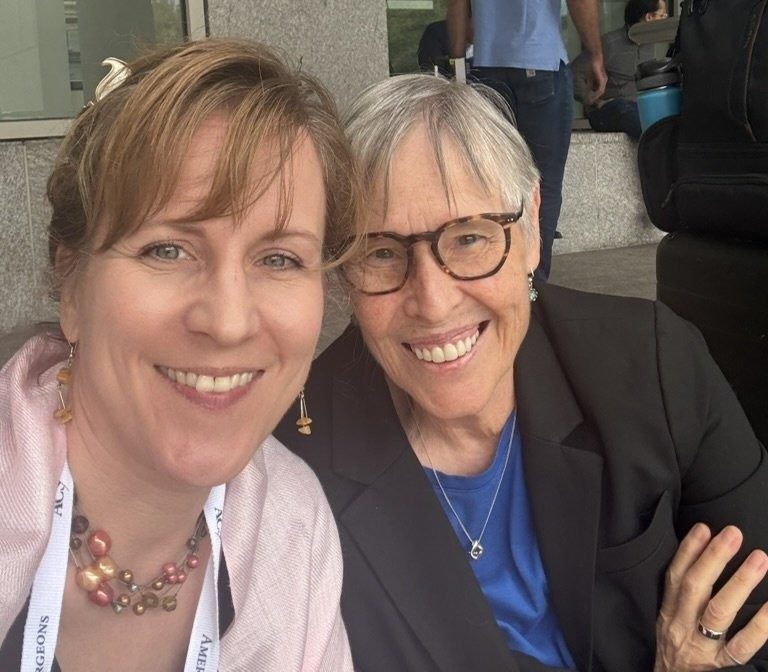
Dr. Mary Brandt

Heather with Dr. Mary Brandt at the 2026 ACS Clinical Congress
With Mary Brandt at the ACS Clinical Congress, 2026

Mary Brandt is a pediatric surgeon and Distinguished Emeritus Professor of Surgery, Pediatrics, and Medical Ethics at Baylor College of Medicine. She received the 2023 Ladd Medal, the highest honor in American pediatric surgery, and she also holds a Master of Divinity. For nearly twenty years she has been teaching surgeons about compassion fatigue, burnout, and what it takes to sustain a life in surgery.

Her work keeps two things in view at once: what an individual surgeon can do to stay whole, and what the culture and business of medicine are doing to the people inside it. Self-care alone isn’t enough, she argues, and she calls for a new approach she names Well-Being 3.0.

Watch and listen

Rethinking Physician Wellness: Is It Time for a Revolution? Grand rounds, Houston Methodist DeBakey Heart & Vascular Center, April 2025.
Read: a selection of Dr. Brandt’s writing

A selection. Dr. Brandt has published more than 245 papers, most of them in pediatric surgery; her CV also lists two decades of lectures on compassion fatigue, burnout, and the ethics of self-care, including the University at Buffalo’s Butsch Memorial Lecture in 2018, “Why are Surgeons Leaving Surgery – And What Can We Do About it?”

Resources

Support, advocacy, and further reading

If you need support now

If someone is in immediate danger, call 911. Details last checked October 15, 2026.

Advocacy and policy
Further reading
Elsewhere on this site
Connect

Working on this where you are?

If you’re working on licensing or credentialing reform, peer support, suicide prevention training, or trauma-informed practice at your institution, I’d like to hear what you’re doing and what you’re running into.

Please don’t use the contact form for urgent support. Call or text 988.

Why is it still so hard for physicians to seek the very care we are trained to provide?

← Societies  ·  Resources →