#ILookLikeASurgeon: stance and engagement on Twitter/X for identity construction and community building
Luzón MJ, Círculo de Lingüística Aplicada a la Comunicación, 2026
Explored in #ILookLikeASurgeon
The research behind the stories on this site, in one place. Each title links to its source, with the same short summary used on the page where it appears. Books live on Books.
143 references
Luzón MJ, Círculo de Lingüística Aplicada a la Comunicación, 2026
Explored in #ILookLikeASurgeon
Todd K, L’Huillier JC, Jalal K, Logghe H , Jordan J, Flynn W, Guo WA, J Surg Res, 2026My publicationFrom colleagues
In 203,131 geriatric patients with rib fractures, both age and frailty were independently associated with increased mortality — age is not a proxy for frailty.
Explored in Research
Dunn GP, Bulletin of the American College of Surgeons, 2026
His argument that the cultivated capacity to “see” outlasts any particular operative technique sits beside the artistry work gathered on Artistry and Medicine.
Explored in Working with AI · Artistry and Medicine
Abdelsattar JM*, Logghe HJ*, Ann Surg, 2026My publication
Explored in Research
Kandi LA, Shahbandeh JC, Bongiovanni T, Jensen V, Denipah N, Alvord LA, The American Journal of Surgery, 2026
Explored in Native American Health
Indian Health Service, 2026
Explored in Native American Health
Hoyert DL, CDC National Center for Health Statistics, 2026
In 2024, Black women in the United States died of maternal causes at more than three times the rate of White women: 44.8 versus 14.2 deaths per 100,000 live births.
Explored in Advocacy: Health Equity
Wong BO, Hoffman DI, Williams K, et al, J Am Coll Surg, 2026
In November 2025, 28 surgical palliative care experts and researchers met to update the field’s research agenda, and named 11 research gaps.
Explored in Surgical Palliative Care Resource Hub · Surgery & Palliative Care
Tony Peregrin, Bulletin of the American College of Surgeons, 2026
Explored in Mental Health in Medicine
Szczygiel LA, Niba V, Dimick JB, Suwanabol PA, Byrnes ME, Barret M, Annals of Surgery, 2026
The team interviewed 39 practicing surgical faculty at the University of Michigan, a single academic medical center where efforts to strengthen workplace culture, equity, and well-being were already visible and ongoing.
Explored in Belonging in Surgery
Xie S, Schlussel A, Shao J, Annals of Surgery, 2025
The authors describe LGBTQ+ surgeons as a “silent” minority. In survey data from the 2019 American Board of Surgery In-Training Examination, 59.2% of LGBTQ+ surgical trainees reported discrimination, compared with 42.3% of their non-LGBTQ peers.
Explored in Allyship · Belonging in Surgery
American Cancer Society, 2025
Black women are also 38% more likely than White women to die of breast cancer, despite slightly lower incidence.
Explored in Advocacy: Health Equity
National Indian Health Board, 2025
Tribal leaders call for full, mandatory IHS funding of $73.0 billion in FY 2027, including $18.49 billion for hospitals and clinics.
Explored in Native American Health
KFF, 2025
AI/AN people under 65 are three times as likely as White people to be uninsured (21% vs. 7%). Medicaid accounts for $1.3 billion of IHS’s roughly $1.8 billion in third-party collections.
Explored in Native American Health
Indian Health Service, 2025
In fiscal year 2025, the IHS Loan Repayment Program made 1,338 awards (698 new, 640 extensions), totaling $58.8 million.
Explored in Native American Health
Luz HL, Haehl J, Luz CF, Zundel S, Journal of Pediatric Surgery, 2025
Explored in #ILookLikeASurgeon
Bulletin of the Royal College of Surgeons of England, 2024
Explored in #ILookLikeASurgeon
Sheckter CC et al, J Burn Care Res, 2024
Explored in Advocacy: Burn Patient Advocacy
Yamamoto T, Goto K, Kitano S, et al, Surgery Today, 2024
Explored in #ILookLikeASurgeon
Kruser JM, Ashana DC, Courtright KR, et al, Ann Am Thorac Soc, 2024
Explored in Code, Cut, or Comfort · Surgical Palliative Care Resource Hub
Sheckter CC et al, J Burn Care Res, 2024
Explored in Advocacy: Burn Patient Advocacy
Indian Health Service, 2024
More than 60% of IHS appropriations are administered by tribes.
Explored in Native American Health
CDC, 2024
Review committees judged 93% of these pregnancy-related deaths preventable, and 63% happened between one week and one year after delivery.
Explored in Native American Health
Sánchez-Santos R, Cano-Valderrama O, Cirugía Española, 2024
Explored in #ILookLikeASurgeon
Zimmermann, Strohmaier, Herkner, Niederkrotenthaler, Schernhammer, BMJ, 2024
Explored in Mental Health in Medicine · Mental Health in Medicine
Webb-Detiege T, Ochsner Journal, 2024
2.7% → 2.6%: share of U.S. physicians who were Black men, 1940 vs. 2018.
Explored in #BlackMenInMedicine
L’Huillier JC, Logghe HJ , Hua S, Myneni AA, Noyes K, Yu J, Guo WA, J Surg Res, 2024My publicationFrom colleagues
In this cohort, 63 years was the age cutoff at which differences in massive-transfusion futility thresholds between older and younger patients became statistically significant (34 vs. 40 units, p = 0.04) — challenging the conventional use of 65 in trauma research.
Explored in Research
L’Huillier JC, Hua S, Logghe HJ , Yu J, Myneni AA, Noyes K, Guo WA, Am J Surg, 2024My publicationFrom colleagues
Geriatric patients (≥65) reach transfusion futility earlier than younger adults — at 34 units of pRBCs versus 39 units.
Explored in Research
Collins RA, et al.; Cunningham C, senior author, Annals of Surgery, 2024
Explored in Mental Health in Medicine · Mental Health in Medicine
Sheridan KMO, Quinton ND, Surgery Open Science, 2024
Explored in #ILookLikeASurgeon
Lowe C, British Journal of Surgery (abstract), 2023
Explored in #ILookLikeASurgeon
Maisner RS, Silva I, Biswas S, et al, Journal of Surgical Education, 2023
Explored in #ILookLikeASurgeon
Swami et al, International Journal of Cancer Care and Delivery, 2023
From the ten most populous reservations, the median drive was 2.15 hours to the nearest oncologist and 3.37 hours to an NCI-designated cancer center.
Explored in Native American Health
Stevens C, Merk K, Ierulli V, Mulcahey MK, Journal of Surgical Education, 2023
Explored in #ILookLikeASurgeon
Sheckter CC et al, JAMA Netw Open, 2023
Explored in Advocacy: Burn Patient Advocacy
Doherty M, McCowan S, Shaw SCK, British Journal of Hospital Medicine, 2023
Explored in Neurodiversity in the Workplace
Kratzer et al, CA: A Cancer Journal for Clinicians, 2023
Cancer death rates are 18% higher for AI/AN people than for White people even though incidence is only 2% higher, and death rates from liver, stomach, cervical, and kidney cancers are about twice as high.
Explored in Native American Health
Abella et al, Journal of Surgical Research, 2023
Across all surgeries in the ACS NSQIP database (2011–2020), AI/AN patients had slightly higher adjusted odds of 30-day complications than White patients, with contributing comorbidities that included diabetes, heart failure, sepsis, and low albumin.
Explored in Native American Health
Hinshaw DB, Am Surg, 2023
Explored in Surgical Palliative Care Resource Hub
Livergant et al, PLOS Global Public Health, 2023
In a meta-analysis of 67 studies (84 reviewed in all), Indigenous patients had 1.26 times the odds of post-operative complications, 1.34 times the odds of infection, and 1.33 times the odds of reoperation.
Explored in Native American Health
Ariadne Labs, Ariadne Labs, 2023
Explored in Code, Cut, or Comfort · Surgical Palliative Care Resource Hub
Ogunmuyiwa J, Beltrán Ponce S, Seldon C, et al, Advances in Radiation Oncology, 2023
Explored in #ILookLikeASurgeon
Lowe C, British Journal of Surgery (abstract), 2023
Explored in #ILookLikeASurgeon
Malik-Tabassum K, Lamb JN, Seewoonarain S, et al, Annals of the Royal College of Surgeons of England, 2023
Explored in #ILookLikeASurgeon
McCammon SD, Hoffman MR, Ann Palliat Med, 2022
Explored in Surgical Palliative Care Resource Hub · Surgery & Palliative Care
Maisner RS, Kapadia K, Zhu A, et al, Annals of Plastic Surgery, 2022
Explored in #ILookLikeASurgeon
CDC, 2022
More than half of pregnancy-related deaths happen between a week and a year after delivery, and among Black women the leading cause is cardiac.
Explored in Advocacy: Health Equity
Bassette et al, Journal of Surgical Education, 2022
Explored in Surgery & Palliative Care
GBD US Health Disparities Collaborators, The Lancet, 2022
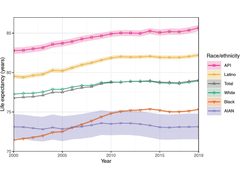
From 2000 to 2019, other groups gained years of life, but life expectancy for AI/AN people did not improve at all (73.1 years in 2019), so the gap with White Americans widened.
Explored in Native American Health
Haroz et al, American Journal of Public Health, 2022
Many tribes chose their own vaccine distribution plans. Some put traditional healers and Native language speakers first, and in Alaska local pilots and sleds carried vaccine to remote villages.
Explored in Native American Health · Native American Health
Sutton, Kills-First, and Sheppard, Bulletin of the American College of Surgeons, 2022
Native American patients are less likely to get curative cancer operations and follow-up treatment. The authors argue that bringing more Native people into medicine is key to rebuilding trust.
Explored in Native American Health
CDC National Center for Health Statistics, 2022
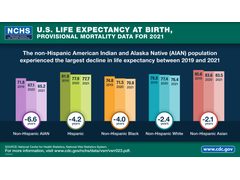
Life expectancy for American Indian and Alaska Native people fell to 65.2 years in 2021, the same as the whole U.S. population in 1944, and dropped 6.6 years from 2019 to 2021.
Explored in Native American Health
Forrest et al, JAMA Network Open, 2022
AI/AN people had 63% lower odds of applying to medical school and 48% lower odds of holding full-time faculty positions than White peers.
Explored in Native American Health
Eberth et al, Health Affairs, 2022
In the lower 48, more than 55% of rural ZIP code areas with the highest share of Native residents were more than 30 miles from a hospital with intensive care or cardiac care (2019 data).
Explored in Native American Health
Ansari H, Pitt SC, The American Journal of Surgery, 2021
Explored in #ILookLikeASurgeon
Sarosi A, et al, Journal of Pediatric Surgery, 2021
Explored in Mental Health in Medicine
Ahmed M, Hamilton LC, Bone & Joint Open, 2021
Explored in #ILookLikeASurgeon
Rialon KL, et al, Journal of Pediatric Surgery, 2021
Explored in Mental Health in Medicine
Sharp SP, Mackenzie DG, Ong DSY, Mountziaris PM, Logghe HJ , Ferrada P, Wexner SD, Am Surg, 2021My publication
At the ACS Clinical Congress 2018, 4,386 tweets were posted by 1,023 accounts — but engagement was concentrated: just 19% of tweeters accounted for 80% of retweets.
Explored in Research
Epstein A, Homer N, Watson A, Nakra T, Bratton E, Somogyi M, The American Journal of Cosmetic Surgery, 2021
Explored in #ILookLikeASurgeon
Grossman R, Sgarbura O, Hallet J, Søreide K, Langenbeck’s Archives of Surgery, 2021
Explored in #ILookLikeASurgeon
Berman L, et al, Journal of Pediatric Surgery, 2021
Explored in Mental Health in Medicine
Ellison, Lau, Cook, Hoffman, Berlin, ACS RISE, 2021
Explored in Surgery & Palliative Care
Lim WH, Wong C, Jain SR, et al, PLOS ONE, 2021
Explored in #ILookLikeASurgeon
Corsini EM, Luc JGY, Antonoff MB, Journal of Thoracic Disease, 2021
Explored in #ILookLikeASurgeon
Corsini EM, Boeck MA, Hughes KA, Logghe HJ, Pitt SC, Stamp NL, Antonoff MB, The American Surgeon, 2020My publication
Women make up only 19% of the surgical workforce despite representing more than half of U.S. medical school enrollees — a gap that social media is uniquely positioned to help close.
Explored in #ILookLikeASurgeon · Research
Campbell KM et al, JAMA Network Open, 2020
35,315: additional graduates five closed historically Black medical schools might have trained by 2019.
Explored in #BlackMenInMedicine
Brandt ML, Journal of Pediatric Surgery, 2020
Explored in Mental Health in Medicine
Mishori R, Singh L, Lin KW, Wei Y, Journal of the American Board of Family Medicine, 2019
Explored in #ILookLikeASurgeon
Albert AA, Knoll MA, Doke K, et al, Advances in Radiation Oncology, 2019
Explored in #ILookLikeASurgeon
Ghanem O, Logghe HJ , Tran BV, Huynh D, Jacob B, Surg Endosc, 2019My publication
This was the first pilot offering CME credit through a closed Facebook group — using the International Hernia Collaboration (IHC), a global surgical community of 5,400+ members, as the test bed.
Explored in Research
Indian Health Service, 2019
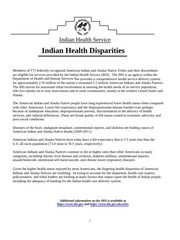
AI/AN people living in IHS service areas have a life expectancy 5.5 years shorter than the U.S. all-races population. Compared with all Americans, their death rates are 3.2 times higher from diabetes, 4.6 times higher from chronic liver disease, and 2.5 times higher from unintentional injuries.
Explored in Native American Health
e-Patient Dave, BMJ (letter), 2019
Explored in Patient Voices
Onyango JM, Bowe SN, Journal of Graduate Medical Education, 2019
Explored in #ILookLikeASurgeon
Stamp NL, Luc JGY, Ouzounian M, Bhatti F, Ni Hici T, Antonoff MB, Interactive CardioVascular and Thoracic Surgery, 2019
Explored in #ILookLikeASurgeon
Alkhammash R, International Journal of English Linguistics, 2019
Explored in #ILookLikeASurgeon
U.S. Commission on Civil Rights, 2018
Federal programs serving Native Americans, including IHS, remain chronically underfunded, and IHS spending per person stays well below other federal health programs.
Explored in Native American Health
Bucknor A, Christensen J, Kamali P, et al, Plastic and Reconstructive Surgery Global Open, 2018
Explored in #ILookLikeASurgeon
Chi et al, Journal of Public Health Dentistry, 2018
In Yukon-Kuskokwim Delta communities from 2006 to 2015, more treatment days from dental therapists were linked to more preventive care and fewer tooth extractions in children and adults, with no rise in general anesthesia for children.
Explored in Native American Health
U.S. Government Accountability Office, 2018
About 25% of provider positions were vacant across the eight IHS Areas that deliver substantial direct care (as of 2017), with rural locations and lack of housing among the biggest barriers.
Explored in Native American Health · Native American Health
U.S. Government Accountability Office, 2018
IHS spent $4,078 per person in 2017, compared with $8,109 for Medicaid, $10,692 for the VA, and $13,185 for Medicare.
Explored in Native American Health
Subramaniam S, Aalberg JJ, Soriano RP et al, J Am Coll Surg, 2018
A five-item frailty index built from ACS NSQIP variables.
Explored in Surgical Palliative Care Resource Hub
Lilley EJ, Cooper Z, Schwarze ML, Mosenthal AC, Ann Surg, 2018
Explored in Surgical Palliative Care Resource Hub
White AA 3rd, Logghe HJ , Goodenough DA, Barnes LL, Hallward A, Allen IM, Green DW, Krupat E, Llerena-Quinn R, J Racial Ethn Health Disparities, 2018My publication
Explored in Research
Logghe HJ, Selby LV, Boeck MA, Stamp NL, Chuen J, Jones C, Journal of Surgical Research, 2018My publication
Twitter advances all five core values of the Association for Academic Surgery: inclusion, leadership, innovation, scholarship, and mentorship — making it uniquely aligned with academic medicine’s mission.
Explored in #ILookLikeASurgeon · Research
Logghe HJ, Rouse T, Beekley A, Aggarwal R, AMA Journal of Ethics, 2018My publicationFrom colleagues
The “abrasive white male surgeon” stereotype is not just inaccurate — it actively harms patients who lower their expectations for respectful care, deters medical students from surgical careers, and distorts how colleagues interact with surgeons who don’t fit the mold.
Explored in #ILookLikeASurgeon · Research · Speaking & Press · Writing
Sheckter CC et al, Burns, 2018
Explored in Advocacy: Burn Patient Advocacy
Brady RRW, Chapman SJ, Atallah S, Chand M, Mayol J, Lacy AM, Wexner SD, British Journal of Surgery, 2017
Explored in #ILookLikeASurgeon
Logghe H, Jones C, McCoubrey A, Fitzgerald E, BMJ, 2017My publication
By 2017 — two years in — #ILookLikeASurgeon had been included in over 150,000 tweets by 35,000 users, generating nearly a billion impressions : proof that a single tweet can reshape a cultural conversation at scale.
Explored in #ILookLikeASurgeon · #ILookLikeASurgeon · Research
Taylor LJ, Nabozny MJ, Steffens NM, et al, JAMA Surg, 2017
Explored in Code, Cut, or Comfort · Surgical Palliative Care Resource Hub
Greenberg CC, Journal of Surgical Research, 2017
Explored in #ILookLikeASurgeon · #ILookLikeASurgeon · Podcasts
Logghe HJ , Boeck MA, Gusani NJ, Aulet TH, Bhayani NH, Bryczkowski SB, Chuen J, Cohen ME, Hoyt DB, Huang LC, Ibrahim AM, Jones CD, Klingensmith ME, Kothari AN, Litle VR, Nagarajan N, Najarian KA, Pigazzi A, Scarlet S, Selby LV, Stamp NL, Whisler J, Wren SM, J Am Coll Surg, 2017My publication
The first formal consensus statement on social media use from a major surgical organization — establishing professional norms at a moment when physician social media was expanding rapidly but without institutional guidance.
Silva MM, Freischlag JA, Journal of Thoracic and Cardiovascular Surgery, 2017
Explored in #ILookLikeASurgeon
Hall DE, Arya S, Schmid KK et al, JAMA Surg, 2017
A frailty measure developed and validated in surgical populations.
Explored in Surgical Palliative Care Resource Hub
Logghe HJ, McFadden CL, Tully NJ, Jones C, Clinics in Colon and Rectal Surgery, 2017My publication
Surgeons’ adoption of Twitter mirrors laparoscopy’s trajectory: initial skepticism, debates about safety and professionalism, then gradual mass adoption driven by demonstrated value.
Explored in #ILookLikeASurgeon · Research
Dyrbye et al, Mayo Clinic Proceedings, 2017
Explored in Mental Health in Medicine · Mental Health in Medicine
Brandt ML, American Journal of Surgery, 2017
Explored in Mental Health in Medicine
Antonoff MB, Stamp N, Journal of Thoracic and Cardiovascular Surgery, 2017
Explored in #ILookLikeASurgeon
Bullock et al, MMWR, 2017
After IHS built team-based, population-focused diabetes care, later strengthened by the Special Diabetes Program for Indians (created by Congress in 1997), diabetes-related kidney failure among AI/AN adults fell 54% from 1996 to 2013, the steepest drop of any group. By 2013 the rate among AI/AN adults with diabetes matched the rate among white adults with diabetes.
Explored in Native American Health
Pitt SC, Journal of Thoracic and Cardiovascular Surgery, 2017
Explored in #ILookLikeASurgeon
Joe et al, American Indian and Alaska Native Mental Health Research, 2016
At the Chinle Comprehensive Health Care Facility on the Navajo Nation, traditional Navajo practitioners are on staff and work with physicians every day in the hospital and clinics, offering cultural diagnostic services, joining rounds and training staff. Patients, families and many providers valued having them there.
Explored in Native American Health
Dimick JB, Journal of Surgical Research, 2016
Explored in #ILookLikeASurgeon · #ILookLikeASurgeon
Logghe HJ, Boeck MA, Atallah SB, Annals of Surgery, 2016My publication
Social media overcomes the core limits of traditional academic communication: time delays, peer-review gatekeeping, and conference costs that exclude many voices.
Explored in #ILookLikeASurgeon · Research
Logghe HJ, Pellino G, Brady R, McCoubrey AS, Atallah S, Tech Coloproctol, 2016My publication
Twitter lets colorectal surgeons connect, debate, and collaborate in real time across geographic and institutional boundaries — something traditional journals and conferences cannot.
Explored in Research
Lilley EJ, Khan KT, Johnston FM, et al, JAMA Surg, 2016
Explored in Surgical Palliative Care Resource Hub
Hoffman KM, Trawalter S, Axt JR, Oliver MN, Proceedings of the National Academy of Sciences, 2016
In one study, about half of White medical students and residents endorsed false beliefs about biological differences between Black and White people, such as thicker skin, and those who held more of them rated a Black patient’s pain lower and made less accurate treatment recommendations.
Explored in Advocacy: Health Equity
Cooper Z, Koritsanszky LA, Cauley CE, et al, Ann Surg, 2016
Explored in Surgical Palliative Care Resource Hub
Hughes KA, Bulletin of the American College of Surgeons, 2015
Explored in #ILookLikeASurgeon
Logghe H, The BMJ Opinion, 2015My publication
Explored in #ILookLikeASurgeon · Speaking & Press · Speaking & Press
AAMC (via AMA), 2015
542 → 515 Black men entering U.S. medical schools, 1978 vs. 2014.
Explored in #BlackMenInMedicine
Schwarze ML, Brasel KJ, Mosenthal AC, JAMA Surg, 2014
Explored in Surgical Palliative Care Resource Hub
Protopapa KL, Simpson JC, Smith NC et al, Br J Surg, 2014
Estimates the risk of death within 30 days of inpatient surgery. The site now recommends its combined SORT and clinical-judgment model.
Explored in Surgical Palliative Care Resource Hub
Smith, Freyd, American Psychologist, 2014
Explored in Mental Health in Medicine
Espey et al, American Journal of Public Health, 2014
From 1999 to 2009 the all-cause death rate for AI/AN people was 46% higher than for White people, and much of that excess is addressable with known public health interventions.
Explored in Native American Health
SAMHSA, 2014
Explored in Advocacy: Trauma-Informed Care
Bilimoria KY, Liu Y, Paruch JL et al, J Am Coll Surg, 2013
Procedure-specific estimates of complications and other outcomes after surgery, from a patient’s preoperative risk factors.
Explored in Surgical Palliative Care Resource Hub
PRAISE Investigators, The Lancet, 2013
1 in 6 women seen in orthopaedic fracture clinics reported IPV in the past year, and 1 in 3 over their lifetime, in a study of 2,945 women at 12 clinics in five countries.
Explored in Advocacy: Intimate Partner Violence
Driscoll et al, Annals of Family Medicine, 2013
After Southcentral Foundation took over primary care from IHS in 1998 and built a patient-centered medical home, all of its emergency care measures trended down.
Explored in Native American Health
Gottlieb, International Journal of Circumpolar Health, 2013
Southcentral Foundation, an Alaska Native–owned health system in Anchorage, rebuilt care around relationships. The Alaska Native people it serves are “customer-owners” who help shape their own services, and it serves more than 60,000 people.
Explored in Native American Health
Logghe H , Maa J, Schwartz J, Bull Am Coll Surg, 2013My publication
Among the earliest documented analyses of Twitter use at a major surgical conference — written at a moment when physician social media was still widely dismissed as unprofessional or trivial.
Explored in Research
Mosenthal AC, Weissman DE, Curtis JR, et al. IPAL-ICU Project Advisory Board and the Center to Advance Palliative Care, Crit Care Med, 2012
Explored in Surgical Palliative Care Resource Hub
Yourman LC, Lee SJ, Schonberg MA et al, JAMA, 2012
Online calculators built from published prognostic indices for older adults.
Explored in Surgical Palliative Care Resource Hub
Indian Health Service, 2012
Explored in Native American Health
Gagne JJ, Glynn RJ, Avorn J et al, J Clin Epidemiol, 2011
Combines conditions from the Charlson and Elixhauser indices to predict mortality in older adults.
Explored in Surgical Palliative Care Resource Hub
Maxine Brings Him Back-Janis, Health Affairs “Narrative Matters”, 2011
The author spent 24 years as an IHS dental assistant and writes in the first person about oral health on the Pine Ridge Reservation.
Explored in Native American Health
Dunn GP, Surg Clin North Am, 2011
Explored in Surgical Palliative Care Resource Hub
Kwok AC, Semel ME, Lipsitz SR, et al, Lancet, 2011
Explored in Surgical Palliative Care Resource Hub
Temel et al, New England Journal of Medicine, 2010
Explored in Palliative Care vs. Hospice
Earnest MA, Wong SL, Federico SG, Academic Medicine, 2010
“Action by a physician to promote those social, economic, educational, and political changes that ameliorate the suffering and threats to human health and well-being that he or she identifies through his or her professional work and expertise.”
Explored in Advocacy
Mosenthal AC, Murphy PA, Barker LK, et al, J Trauma, 2008
Explored in Surgical Palliative Care Resource Hub
Connor et al, Journal of Pain and Symptom Management, 2007
Explored in Palliative Care vs. Hospice
Rockwood K, Song X, MacKnight C et al, CMAJ, 2005
A judgment-based, 9-point scale summarizing an older adult’s overall fitness or frailty (version 2.0, 2020). Dalhousie asks users to complete a permission-for-use agreement.
Explored in Surgical Palliative Care Resource Hub
Surgeons Palliative Care Workgroup, J Am Coll Surg, 2003
Explored in Surgical Palliative Care Resource Hub
Dunn GP, Milch RA, Mosenthal AC, et al, J Am Coll Surg, 2002
Explored in Surgical Palliative Care Resource Hub
Dunn GP, Milch RA, J Am Coll Surg, 2001
Explored in Surgical Palliative Care Resource Hub
Pirovano M, Maltoni M, Nanni O et al, J Pain Symptom Manage, 1999
Combines the clinician’s prediction of survival with performance status, symptoms, and blood counts to group patients with advanced cancer by 30-day survival.
Explored in Surgical Palliative Care Resource Hub
Maltoni M, Nanni O, Pirovano M et al, J Pain Symptom Manage, 1999
Explored in Surgical Palliative Care Resource Hub
Morita T, Tsunoda J, Inoue S et al, Support Care Cancer, 1999
Combines the PPS with oral intake, edema, dyspnea at rest, and delirium to estimate survival in terminally ill patients with cancer.
Explored in Surgical Palliative Care Resource Hub
Anderson F, Downing GM, Hill J et al, J Palliat Care, 1996
Functional performance in 10% steps, from ambulation and activity to self-care, intake, and consciousness. Copyright Victoria Hospice Society; clinical, teaching, and research use needs their permission.
Explored in Surgical Palliative Care Resource Hub
Charlson ME, Pompei P, Ales KL et al, J Chronic Dis, 1987
Weights comorbid conditions to predict mortality.
Explored in Surgical Palliative Care Resource Hub
CDC
More than 1 in 3 women in the U.S., and more than 1 in 6 men, have experienced contact sexual violence, physical violence, or stalking by an intimate partner in their lifetime.
Explored in Advocacy: Intimate Partner Violence
University of North Dakota School of Medicine & Health Sciences
In 1972 there were only 26 American Indian physicians in the country. Since its founding in 1973, INMED has supported the graduation of more than 280 American Indian physicians, with programs from seventh grade through graduate school.
Explored in Native American Health
Nothing matches yet. Try a shorter word, or choose All topics.